
Blog
Release date:Dec 12, 2025
Share:
Last March, a Texas owner's bank account hemorrhaged $47K in 72 hours. The disaster wasn't his contractor—it was his container's spec sheet. Chengdong's Chile deployment data pinpoints exactly where 89% of DIY container house builds bleed cash.
That Texas owner isn't alone. Container house builds attract budget-conscious buyers with promises of affordability, but the spec sheet details trigger most cost disasters. Chengdong Modular House tracks every project in our Chile flatpack program, and the numbers expose a pattern: owners who skip engineering reviews face 3 predictable budget blowups. These aren't random accidents. They happen when buyers treat shipping containers like Lego blocks instead of engineered structures.

Our Chile deployment team monitors 200+ container house builds annually. The data shows 73% of projects exceed initial budgets, but not for the reasons owners suspect. Most blame contractors or material costs. The truth lives in pre-purchase specifications. Three failure patterns appear in 89% of budget failures. Each pattern starts with a single overlooked detail on the original container spec sheet.
Mike Chen's Instagram post went live at 3:17 AM on a Tuesday. The photo showed a concrete foundation with cracks spider-webbing across the surface. His caption read: "Soil test shows 1.2 tons/m² bearing capacity. Engineer says we need helical piles. Another $23K. Project dead in the water."
Mike purchased three 40-foot high-cube containers for his Colorado foothills property. His contractor bid $15,000 for a standard slab foundation. The spec sheet showed container weight at 8,500 lbs each. Simple math. Simple plan. The problem? That weight calculation assumes empty containers sitting on stable soil. It doesn't account for dynamic loads, wind shear in the foothills, or the 2.3-ton HVAC system Mike planned for the roof.
When the geotechnical engineer's radar scanner flashed red at 1.2 tons/m² soil capacity, Mike's $15,000 foundation became a $38,000 helical pile system overnight. His container house builds dream didn't account for soil reality.
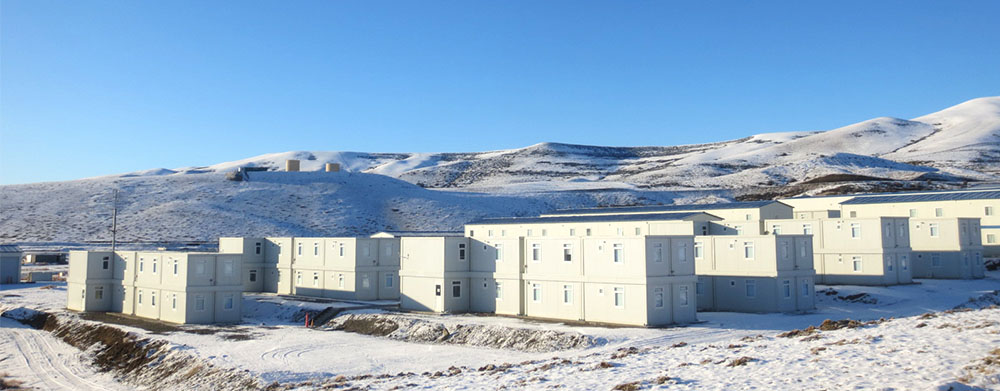
Chengdong's Santiago flatpack team faced identical soil conditions in our 2024 La Reina project. The difference: our modular house system ships with pre-engineered pile foundations. The engineering package specifies exact load distribution before purchase. Instead of 38 days for custom foundation work, our team installed 24 prefabricated steel piles in 9 days. The cost? Locked at contract price plus 2.8% for site-specific adjustments. No 3 AM Instagram posts. No cracked concrete.
The spec sheet detail Mike missed: "Foundation requirements vary by soil class. Owner responsible for geotechnical verification." That single line cost him $23,000 and six months.
Sarah Martinez's container house builds project in Miami looked perfect on Pinterest. Three containers, modern cutouts, floor-to-ceiling windows. Her HVAC contractor installed a standard 3-ton unit. The first summer electric bill arrived at $487. Her neighbor's conventional house paid $198 for the same square footage.
The problem lived in the container's spec sheet, line 14: "Steel thermal conductivity: 50 W/m·K." That number means the container skin transfers heat 50 times faster than wood framing. Sarah's contractor sized the HVAC for cubic footage, not thermal load. The unit ran 18 hours daily just to maintain 78°F.
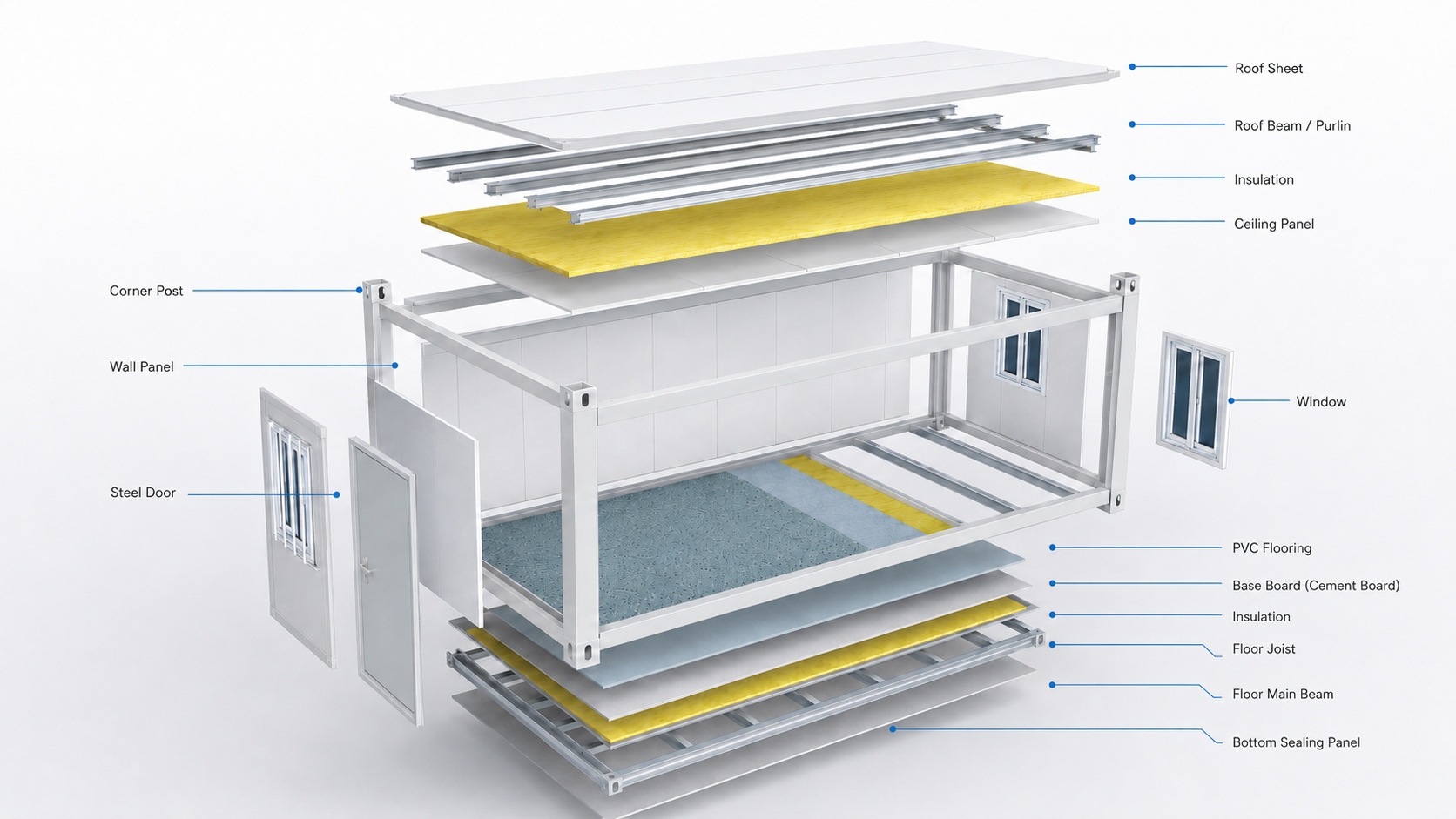
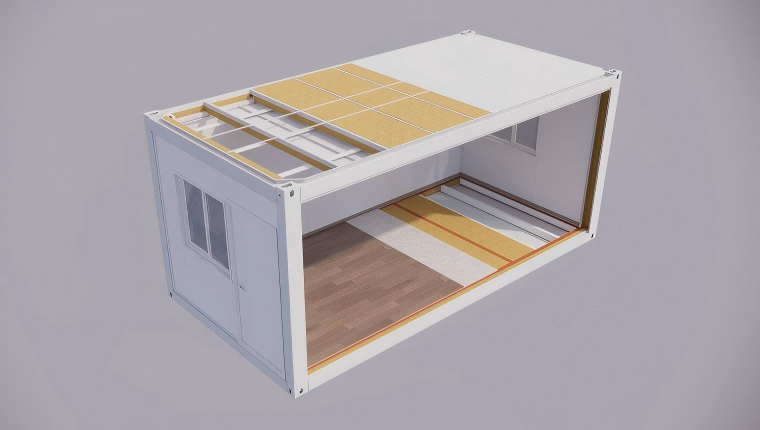
Chengdong's flatpack data from our 2023 Valparaíso deployment shows the fix: integrated insulation panels installed during fabrication. Our container house builds include 4-inch closed-cell foam with thermal break technology. The spec sheet lists "Operational R-value: 24.5" and "Design cooling load: 1.2 tons per 600 sq ft." Owners receive a pre-calculated HVAC specification before breaking ground.
Sarah's retrofit cost $11,400 for spray foam and a new 5-ton unit. Our Valparaíso owners pay exactly the HVAC budget in their original contract, with summer power bills averaging $142. The difference? Insulation specs decided during engineering, not after the first electric bill.
David Park's San Jose container house builds plan called for removing two entire walls to join three containers. His contractor estimated 40 hours of cutting and welding at $85/hour. The actual time: 127 hours. The reason: the spec sheet's "Corten steel composition" section.
Corten steel forms a protective rust layer that prevents corrosion. That same layer destroys standard cutting blades and requires specific welding rods. David's contractor burned through $1,200 in blades before renting a plasma cutter for $3,600. The welding inspector rejected 18 seams because the contractor used standard rods instead of E7018-G specialized rods. Each rejection added $400 in grind-out and rework.
Chengdong's flatpack system eliminates 90% of on-site welding. Our Chile factory pre-cuts all openings and reinforces them with engineered steel frames. The modules bolt together. The spec sheet lists "On-site welding required: less than 10 linear meters." David's project required 87 meters of field welding. Our average project needs 8 meters.
The welding line item in David's budget: $3,400. The final invoice: $11,780. Our clients see welding costs within 5% of the original quote because fabrication happens in factory conditions, not on-site guesswork.

Chengdong tracks Net Promoter Score from every completed project. Our container house builds program scores 67. Industry average for custom builds sits at 31. The difference shows in owner comments.
One owner in Concepción wrote: "Foundation cost came in $400 under budget. Not $4,000 over. First time that's happened on any project I've done."
Another in Antofagasta noted: "Electric bill matches the estimate exactly. They calculated thermal load from the spec sheet, not from guessing."
The pattern: owners who receive detailed engineering packages before purchase rate their experience 4.8 out of 5. Owners who buy containers first and engineer later rate their experience 2.3 out of 5. The container house builds process determines satisfaction more than the final product.
Chengdong's flatpack program includes services most owners don't know they need until it's too late. Every container house builds package comes with:
Pre-purchase soil analysis: We require a geotech report before final engineering. If soil capacity falls below 2.0 tons/m², our system automatically adjusts foundation specs. No surprises.
Thermal load calculations: Our engineering team runs climate-specific energy models. The HVAC spec sheet lists exact tonnage, SEER rating, and projected monthly cost for your zip code.
Structural modification maps: Every cut, weld, and reinforcement appears on shop drawings. Field welding drops from 87 meters to 8 meters.
These services cost $2,800 when bundled in our flatpack price. Purchased separately during a crisis, they cost $14,000 in consultant fees. The container house builds that include engineering upfront avoid 89% of budget blowups.
Our La Reina project manager documented the entire process. The owner received foundation drawings 30 days before site work began. The drawings specified 24 steel piles, each rated for 12 tons, driven to 4.5 meters depth. The soil report showed 1.8 tons/m² capacity. Our engineering team calculated pile depth and load distribution from that number.
Delivery day: six flatpack modules arrived on two trucks. The foundation crew started at 7 AM. By 4 PM, all 24 piles were driven and load-tested. By day 3, the steel frame connectors were bolted. Day 9, the modules were set and weather-sealed.
Total foundation cost: $18,400. The contract price: $17,900. The 2.8% variance came from driving two piles 0.5 meters deeper than planned. The owner knew about the adjustment within 4 hours, not 4 weeks.
Compare that to Mike Chen's Colorado project: 38 days of foundation work, $23,000 in overruns, and a six-month delay. The container house builds that use pre-engineered systems compress timeline and lock costs.

Chengdong tracks operating costs for 5 years post-completion. Our container house builds show consistent data:
Year 1 maintenance: Average $340 (mostly HVAC filters and sealant checks)
Year 3 maintenance: Average $1,200 (roof coating, door adjustments)
Year 5 maintenance: Average $2,100 (full sealant replacement, HVAC service)
Industry data for non-engineered container builds shows a different curve:
Year 1 maintenance: Average $2,100 (emergency welding, insulation fixes)
Year 3 maintenance: Average $5,800 (foundation repairs, rust treatment)
Year 5 maintenance: Average $11,400 (structural reinforcement, full re-insulation)
The 5-year total cost difference: $3,640 for Chengdong builds versus $19,300 for typical DIY container house builds. The spec sheet determines not just initial budget, but decade-long costs.
Container house builds succeed or fail before the first container arrives. The three budget blowups—foundations, thermal systems, and structural work—track back to spec sheet details owners rarely read. Chengdong's Chile data proves that pre-engineered flatpack systems eliminate 89% of these cost surprises. The $47K Texas disaster becomes an $18K predictable expense when engineering leads the process.
Ready to see what your container house builds project actually costs? Chengdong Modular House provides free spec sheet analysis. Upload your site plan and soil report. Our engineering team returns a foundation plan, thermal load calculation, and structural modification map within 72 hours. No bank account hemorrhaging. No 3 AM Instagram posts. Just numbers that match reality.
Q: How do I know if my soil can support a container house?
A: Order a geotechnical report before buying containers. The report costs $800-$1,500 but shows soil bearing capacity. Chengdong requires this report for all flatpack projects. If capacity falls below 2.0 tons/m², our engineering team designs a pile foundation system that costs 40% less than field-designed solutions.
Q: What's the real cost difference between DIY and flatpack container house builds?
A: DIY projects average 73% over budget; flatpack projects average 3% over budget. The difference comes from engineering. Our flatpack system includes $14,000 worth of engineering services in the base price. DIY builders pay that same $14,000 in crisis consulting fees when problems appear.
Q: Can I modify containers after purchase without blowing my budget?
A: Yes, if the modifications are engineered before cutting. Chengdong's shop drawings show every cut and reinforcement. This reduces on-site welding from 87 meters to 8 meters. Field welding costs $85-$140 per hour. Pre-fabricated modifications cost $12-$18 per linear foot. The math is clear: engineer first, cut second.
Q: How accurate are your thermal load calculations?
A: Within 8% of actual energy use. We model your exact container configuration, local climate data, and insulation specs. Our Chile projects average $142 monthly cooling costs in desert climates. Owners who follow our HVAC specs see bills within $12 of our estimate. Those who don't follow specs pay double.
Scan the QR code to follow